
Reading a provider's record.
A record is what makes people copy a provider. This site reads the public pages of cTrader Copy, lists the 20 strategy cards its symbol pages show in the order they were created, says what the help pages define and says where the public pages stop. Latest reading: 6 November 2026. It does not rank anyone and does not tell you whom to copy.
Strategy page, provider page and charts as the help pages define them, and the words that mean three things in three places.
20 named cards in creation-date order, a 29-point curve for each, and the cards on which three pages printed three different returns.
Win rate, drawdown and trade history sit behind the application. The page says so, and says what SEC Nigeria has and has not said.
What this site is for
A provider's record is what makes a person copy them. This site is for the reader who wants to look at the record before that, and who would like to know what it can and cannot show. It reads the public pages of cTrader Copy, lists the twenty strategy cards that its symbol pages show, quotes what its help pages define, and says where the public pages stop. Everything is dated: the latest reading is 6 November 2026.
It does not say whether any provider is good, honest or worth copying. It has no way to know, and a site that pretended to would be selling something.
What a record is made of
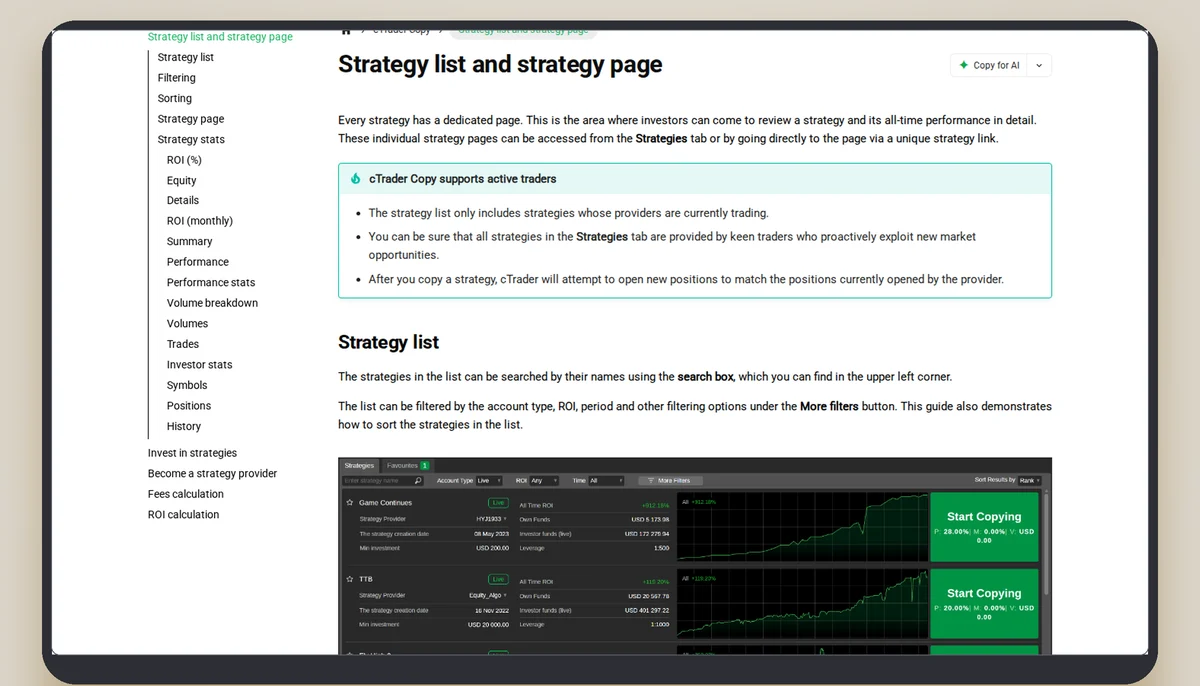
On cTrader Copy a record is a strategy page and a provider page: an account type icon, an age, an all-time return, an equity chart, a return chart, a summary with figures such as maximum balance drawdown, percent profitable and profit factor, a performance section and a table of trades. The public symbol pages show far less: a card with a nickname, a strategy name, a printed return, a minimum investment, a creation date, the symbols traded and a small curve.
What the help pages define, and where the figure sits
Ten items a reader meets on a strategy or provider page, with the place where this site could read each one. Read 6 November 2026.
| Item | Defined on the help pages | Readable on a public page |
|---|---|---|
| Equity chart | Yes | Definition only |
| Return (ROI) chart and monthly return | Yes | Definition only; a printed return is on each card |
| Max balance drawdown | Yes | Definition only |
| Percent profitable | Yes | Definition only |
| Profit factor | Yes | Definition only |
| Active since | Yes, three meanings | Not on the cards |
| Average profit | Yes | Not on the cards |
| Account type (live or demo) | Yes, as icons | Not in the card data |
| Strategy age | Yes | Yes, as a creation date |
| Symbols traded | Yes | Yes, as a list |
The 20 cards, named and ordered by date
The gold, bitcoin and euro pages of cTrader Copy show the same 20 cards. This site lists them by the date each was created, never by what it printed, so none comes first because of a figure. The oldest is Empire Trades (LogicFX), created on 6 February 2023. The newest is Method (Li5056), created on 18 September 2026. The front page prints "800+" strategies, so these twenty are a small part of the whole, picked by a rule the pages do not give.
A printed return is not one number
The same card printed different returns on different pages saved about eight seconds apart: 6 of the 20 did. The widest gap was 152 percentage points. The cards do not state the period of the return, and the figure is measured on the provider's own balance, so it says nothing about what a copier would have received. That is why returns appear on this site in table cells with a date and never in a heading.
The small curve, and how a fall is read
Each card draws a curve of 29 daily points, from 8 October 2026 to 5 November 2026. 5 of the 20 ended below zero, and 4 fell by ten points or more somewhere along the way. One of them, CR7 (husseinalmoders), printed a return of 5,159% and drew a curve that ended at its lowest point of the four weeks. A big figure and a bad month fit on one card. The page on the curve gives all twenty, with the lowest and highest point, the last point and the largest fall.
Win rate, drawdown, trade history: out of scope
The figures a skeptic asks for first, the win rate, the maximum drawdown and the trade history, sit in the application behind a login. This site reads public pages only and has none of them for any card. It defines them as the help pages do and uses invented numbers to show how a 90% win rate can sit with a loss. It does not estimate any of them from the curves. Live and demo accounts are told apart by icons in the application; the card data has no field for it.
Names that repeat and names that look alike
2 nicknames carry more than one of the 20 cards, one of them 4. Two nicknames differ by one character, a lowercase L and a capital I. The pages do not say whether any of these belong to one person. The page on names shows them in a table and leaves the reading to the reader. A nickname passed in a message is worth checking letter by letter.
A list of survivors
The help pages say the strategy list only includes strategies whose providers are currently trading. A strategy that was stopped is not shown. The age of a card therefore shows survival, and the pages cannot say how many strategies did not survive. 12 of the 20 cards are under a year old.
The front page's headline figures
Under its title the front page of cTrader Copy prints four figures: "800+" strategies, "200+" providers, "117%" top monthly ROI and "10+" metrics. The page does not say what month the 117% belongs to, which strategy it belongs to, or whether the strategy was live or demo. The page does not say how the figure was chosen, and this site reads it only as what it is: a number on a page, dated, with its source named and its meaning not stated.
If you were sent a record
A reader may arrive with a message in hand: a name, a screenshot, a line saying the account is up. The first question to put to it is what it is a record of. Is it a strategy page or a trading platform screen? Is the account live or demo? What period? The pages read say where each of those answers would be on cTrader Copy, and that several of them are only visible inside the application. A person who can show them is showing more than a person who sends a picture.
Why a record needs a period
Every figure on a strategy page is measured over some period, and the period can be changed with a toggle from one week to all time. A return measured over a good week and one measured over all time can both be printed truthfully on the same page. The cards on the symbol pages print a return without the period, which is why this site refuses to treat it as an outcome. A reader who is given a return should be given its dates.
Why the minimum investment is part of the record
The minimum investment on a card is also a rule about leaving: the help pages say funds cannot be withdrawn from a copy-trading account if equity would fall below it while copying goes on. On the twenty cards it runs from USD 100 to USD 50,000. A strategy with a high minimum asks for more money to be committed before any record can be tested, and the card does not say what kind of provider sets it.
What the follower's account adds
A follower's account is a different account. Provider and investor prices may differ because of trading conditions and execution time, the platform says. Trades are not copied when funds, the instrument or margin are missing, and trades in stocks and shares are never copied. The follower pays fees, up to 40% of net profit, 10% of equity a year and USD 10 per million copied, and a provider's own deposits and withdrawals change the size of the follower's positions. None of this is in a provider's printed return.
What SEC Nigeria has said
The Securities and Exchange Commission of Nigeria published a notice on 19 October 2018 saying that online retail forex trading is unregulated, and another on 14 May 2026 about unregistered online investment schemes promoted on social media. Neither mentions copy trading, and this site found no SEC page on copy trading among the pages it read. It says so as a gap. The notices matter to a skeptic because the second asks the public to verify registration before dealing with anyone promoting an investment.
The cTrader front page's list of key metrics
The front page lists six metrics for comparing strategies: return, win rate, profit factor, strategy age, active live investors and maximum drawdown. Of the six, the public cards carry the first, as a printed figure, and the fourth, as a date. The other four sit behind the application. A comparison that uses only the two available ones leaves out the other four, among them the drawdown that the help page itself ties to risk.
A reader's checklist
Which account type, live or demo? Over which period is the return? On what starting balance? Which symbols, and does the reader's broker have them? How deep was the largest balance drawdown, and how long did it take to recover? Did the provider add or withdraw money? Were the fees included? Is the person presenting the record registered, under the exact legal name? Some of these have an answer on a public page, and others do not.
What this site did not do
It did not log in, open an account, copy a strategy or measure a fill. It does not rank providers, name a favourite or list strategies to follow. It states no return as an expectation. A strategy that is not in the table is not worse than one that is; the table is the twenty cards the pages showed.
A short glossary
Provider: the trader whose account is copied. Follower or investor: the account that repeats it. Equity: the balance plus open profit and minus open loss. Balance drawdown: a drop in the account balance from an earlier high. Profit factor: the help page's ratio of net profit to net loss. Percent profitable: winning trades over all trades. A contract for difference is a contract on a price and does not mean owning the thing priced.
How a figure on this site is checked
The pages are saved as read. A second script recounts the cards, their figures and the largest fall inside each curve from the saved files by a different route, and compares. Five defects planted on purpose were each caught. The three printed returns per card were compared page by page, which is how the differences above were found. That checks the copying of numbers, not the accuracy of the platform's pages.
Six pages for the reader who asks for the evidence
- What a record isFields of a strategy page and a provider page, with three meanings of "active since" and three of drawdown.
- The twenty cardsNickname, strategy, creation date, age, minimum and printed return, by date; the 6 cards whose returns disagreed.
- Reading the curveLowest, highest, last point and largest fall of every card over 29 days.
- The numbers behind the appPercent profitable, profit factor and drawdown defined, with invented arithmetic, and stated as out of scope.
- Ages, names and symbolsA list of survivors, repeating and look-alike nicknames, and the symbols counted.
- What a record leaves outLive or demo, changes of style, fills, and two SEC Nigeria notices.
The broker this site links to
The link on this site goes to FxPro, a broker that cTrader's own list flags as copy-enabled. What a copy gives the follower is a leveraged contract on a price and no ownership. The broker's terms come before any decision.